Growth and characterization of advanced functional nanomaterials
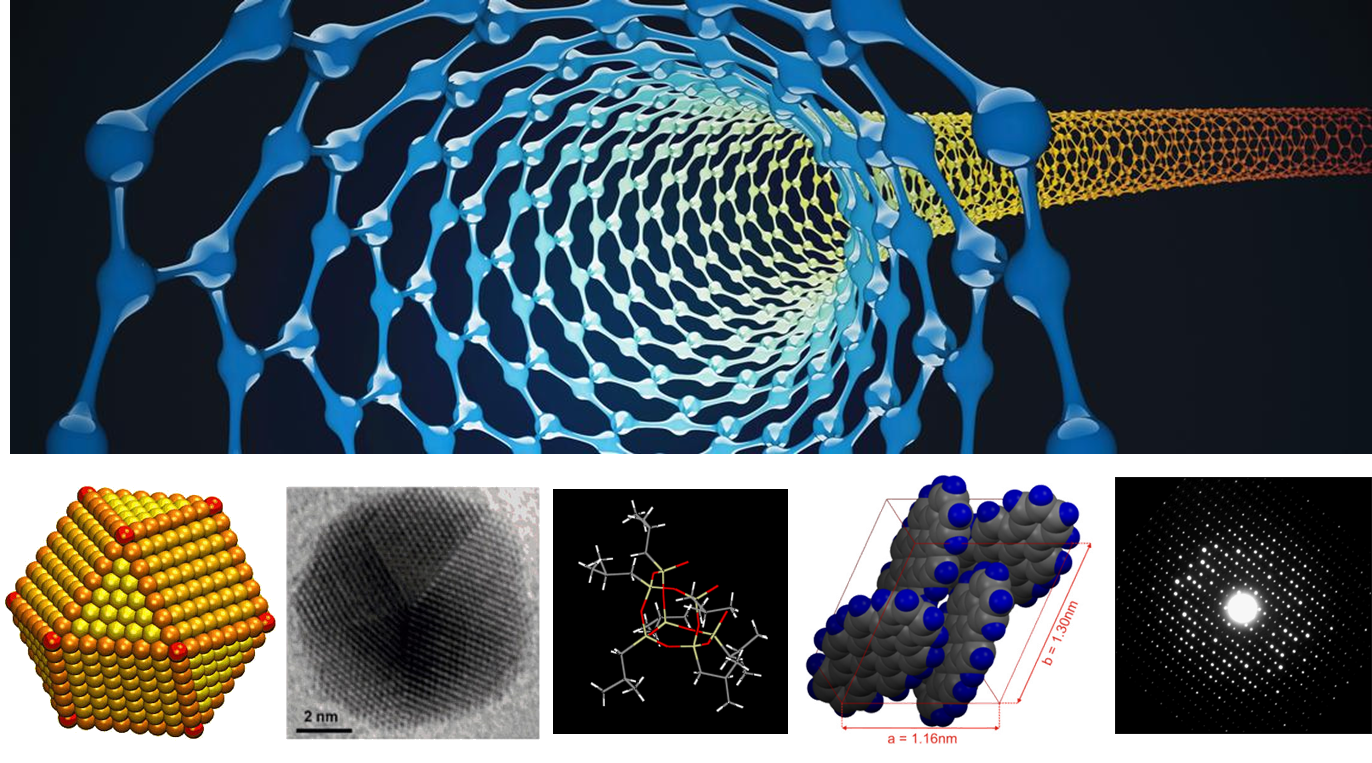
Nanoscience is defined as the study of phenomena and manipulation of materials at atomic, molecular and macromolecular scales, where properties differ significantly from those at a larger scale. The properties of materials can be different at the nanoscale mainly because nanomaterials have a relatively larger surface area when compared to the same mass of material produced in a larger form and quantum effects can begin to dominate the behavior of matter at the nanoscale - affecting the optical, electrical and magnetic behavior of materials. It is this multidisciplinarity and the remarkable variations in the fundamental electrical, optical, structural and magnetic properties that occur when one progresses from an infinitely extended solid to a particle of material consisting of a countable number of atoms, that makes this field so vibrant and exciting. The technological advancement in the microscopic, spectroscopic and physical property measurement tools that now allow atoms and molecules to be examined and probed with greater precision have further enabled the expansion and development of nanoscience and nanotechnologies by triggering immense research work over the last couple of decades.
We try to address several fundamental issues in the context of growth, structure, and ordering of such nanostructures which include - Which types of structures and phases are formed and which parameters characterize the order? How does the order appear and disappear (as a function of coverage or temperature) and what is the nature of phase transitions? How do various degrees of freedom and different constituents of the molecule have an impact on the growth and structure? What are the driving forces of self-assembly? What determines the growth kinetics and growth regimes? What are the internal (e.g. length scale or substrate orientation) and the external (e.g. temperature) control parameters?
Disclaimer: Image courtesy of the internet and other sources. Images are for a representational and educational purpose only. No copyright infringement intended.